Showing posts with label Burundi. Show all posts

Saturday, January 14, 2023

Msiba Boston - Bibi Sipora Minani

 Familia ya Mzee David Mvuyenkure, wa Chelsea, Massachusetts, USA inasikitika kutangaza kifo cha mpendwa wao..Bi Sipora Minani, kilichotokea jan, Ijumaa Tarehe 13, Januari nyumbani kwao.  Alikuwa ni muamini wa siku nyingi wa kanisa la The International Gospel Church, Chelsea, Ma.

Mipango ya mazishi ni yafuatayo:


The Late SIPORA MINANI  

1950 – January 13th, 2023

Wake and Viewing

  Thursday, January 19th, 2023   from 4:00PM to 8:00PM

Vazza Beechwood Funeral Home - 262 Beach St, Revere, MA 02151

Funeral

Friday, January 20th, 2023 

Viewing from 9:30 – 11:00AM

Service 11:00AM – 12:30PM

Vazza Beechwood Funeral Home - 262 Beach St, Revere, MA 02151

Burial 

Woodlawn Cemetery   - 302 Elm St, Everett, MA 02149

Repas Immediately After Burial

The International Gospel Church, 85 Crescent Ave., Chelsea, MA 02150

Saturday, May 12, 2018

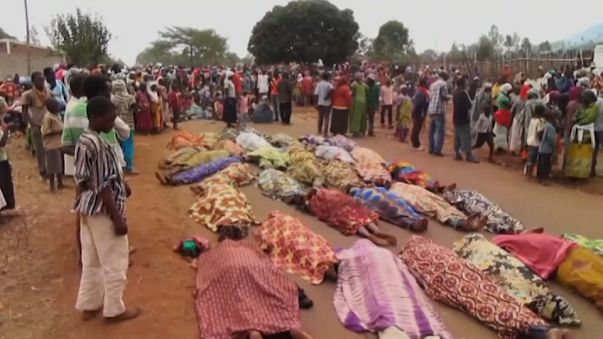
Watu 26 wauawa Burundi Leo!

DEALDY ATTACK IN BURUNDI


By ELOGE WILLY KANEZA
Associated Press

Related image
Archive Photo

   BUJUMBURA, Burundi (AP) - Twenty-six people were killed and seven others wounded in an attack in a rural area of Burundi, the country's security minister said Saturday, calling it the work of a "terrorist group" he did not identify.

   Speaking at the scene, Alain Guillaume Bunyoni told reporters that 24 people were killed in their homes Friday night and two others died of their wounds at a local hospital.

   He gave no further details about the attack in the Ruhagarika community of the rural northwestern province of Cibitoke.

   The attack came shortly before Burundians vote May 17 in a controversial referendum that could extend the president's term. It was not immediately clear if the attack was related.

   One survivor told The Associated Press the attackers came around 10 p.m. local time and "attacked households and set fire on houses." Some victims were hacked with machetes and others were shot or burned alive, she said.

   Her husband and two children were killed, she said. She spoke on condition of anonymity, citing safety concerns.

   This East African country has seen deadly political violence since early 2015 when President Pierre Nkurunziza successfully pursued a disputed third term. An estimated 1,200 people died.

   Now Burundians are being asked to vote on a proposal to extend the president's term from five years to seven, which would allow Nkurunziza to rule for another 14 years when his current term expires in 2020.

   Campaigns ahead of the referendum have been marred by hate speech, with one ruling party official sent to prison after he called for those who oppose the referendum to be drowned.

   The United States earlier this month denounced "violence, intimidation, and harassment" against those thought to oppose the referendum and expressed concern about the "non-transparent process" of changing the constitution.

   Human Rights Watch has noted "widespread impunity" for authorities and their allies, including the ruling party's youth wing, as they try to swing the vote in the president's favor.

   Many in Burundi, a poor country that still relies heavily on foreign aid, worry that a new round of bloodshed will follow the referendum no matter its results.

   Already more than 400,000 people have fled the country since the political unrest began in April 2015, according to the United Nations.

   Nkurunziza, a former rebel leader, rose to power in 2005 following the end of Burundi's civil war that killed about 300,000 people. He was re-elected unopposed in 2010 after the opposition boycotted. He said he was eligible for a third term in 2015 because lawmakers, not the general population, chose him for his first term.


   Follow Africa news at https://twitter.com/AP-Africa


Saturday, March 31, 2018

Clement Nkurunziza Detained in Burundi FOllowing Depportation from USA

Trump kachachaa! Watu wanafukuzwa USA kila siku. Hali mbaya sana!  Kama una rangi na huna makaratasi ulie tu. Trump na ubaguzi wake hana huruma.  Kama una kosa lolote utaondoshwa.

Huyo inasemekana alishiriki katika mauaji ya waHutu wa Burundi.
Mr. Clément nkurunziza was a leader of the university of Burundi gang that killed over a 1000 university students because they were hutus. The USA should not be a hub for criminals like Clément Nkurunziza. Justice should be served. He should be sent to Burundi immediately to face Justice. 


***********************************************************

  KAMPALA, Uganda (AP) - Burundian activists say a man recently deported from the United States after failing to receive political asylum has been detained without charge back home.

   The group iBurundi, which monitors alleged government abuses, says Clement Nkurunziza has had no access to a lawyer since his March 22 arrest.

   Police spokesman Pierre Nkurikiye confirmed Nkurunziza is in custody but gave no details.

   iBurundi says Nkurunziza was arrested after arriving on a plane from the U.S. Over 1,000 people had signed an online petition urging the U.S. not to send Nkurunziza back to Burundi, saying "his life would be in jeopardy."

   Nkurunziza had urged Burundi's president to retire after two terms in 2015. Deadly protests broke out when President Pierre Nkurunziza successfully sought another term. The two men are not related.

   The International Criminal Court judges last year authorized an investigation into allegations of state-sponsored crimes in the East African nation that the U.N. human rights chief recently called one of "the most prolific slaughterhouses of humans in recent times."

Saturday, September 09, 2017

Burundi Refugees Repatriated Home

   DODOMA, Tanzania (AP) - The U.N. refugee agency has started repatriating hundreds of Burundian refugees back home from neighboring Tanzania.

   Emmanuel Maganga, government commissioner for the Kigoma region in northwestern Tanzania, said 300 refugees returned home Thursday using public transport.

   At least 12,000 Burundian refugees have signed up for voluntary repatriation. Maganga said the initial agreement with U.N. officials says 300 Burundians will be repatriated every week.

   More than 240,000 Burundian refugees are sheltering in Tanzania. Most of them fled political violence in 2015 after President Pierre Nkurunziza announced plans to seek a disputed third term that he ultimately won.

   Tanzania's government has been putting pressure on UNHCR to facilitate the repatriation of those refugees who want to return home.

   Burundi's government says the country is now peaceful.

Sunday, February 14, 2016

Maandamano Burundi Dhidi ya Rwanda


Warundi wakiandamana leo
BUJUMBURA, Burundi` (AP) - Thousands of Burundians on Saturday participated in government-sanctioned demonstrations against neighboring Rwanda whom it accuses of supporting a rebellion to topple Burundi's president.

   The demonstrations highlight the souring of relations between the Central African neighbors since Burundi President Pierre Nkurunziza was re-elected for a disputed third term.

   Burundi was rocked by violent street protests for months after Nkurunziza's April announcement that he would seek another term. At least 400 people have died since then in violent street protests, assassinations, attacks by a rebel group and a failed coup attempt. More than 200,000 Burundians have fled to neighboring countries, mostly to Rwanda. Burundi is accusing Rwanda of training and arming rebels in the refugee population.

   Rwanda on Friday said it plans to relocate 75,000 Burundian refugees to other countries following the accusations.

   Burundi's Interior Minister Pascal Barandagiye, in a radio broadcast urging people to participate in the demonstrations, accused the Rwandan government of trying to topple Burundi's government through military means.

   Demonstrators camped at Rwanda's embassy in Bujumbura Saturday morning, singing songs against Rwanda President Paul Kagame.

   The songs described Kagame as an enemy whom Burundians are going to "kumesa." The Kirundi word kumesa means wash. During Burundi's civil war a decade ago, "to wash someone up" was a euphemism for killing people perceived to be enemies.

   A U.N. panel of experts has made similar allegations against Rwanda, saying in a new report that refugees from Burundi received training from Rwandan military personnel last year with the goal of removing Nkurunziza from power. The experts spoke to 18 Burundian combatants who said they had been recruited at the Mahama refugee camp in eastern Rwanda in May and June 2015 and that their numbers total four companies of 100 recruits each.

Saturday, January 30, 2016

Murder in Burundi

By ELOGE WILLY KANEZA and RODNEY MUHUMUZA
Associated Press

   BUJUMBURA, Burundi (AP) - Satellite images, video footage and witness accounts show that dozens of people allegedly killed by Burundian security forces in December were later buried in mass graves, Amnesty International reported Friday.

   The report came as unrest in Burundi escalated with the arrest of 17 people in a security sweep, including two foreign journalists who were released later Friday.

   The rights group reported five possible mass graves in the Buringa area on the outskirts of the capital, Bujumbura, which has been wracked by violence as the security forces go into neighborhoods seen as opposition strongholds. Two journalists on assignment for the French newspaper Le Monde were among 17 people swept up in a military operation Thursday, said Moise Nkurunziza, a deputy spokesman for Burundian police.

   Journalists Jean-Philippe Remy of France and British photographer Philip Edward Moore were released on Friday afternoon, Le Monde said.

   Witnesses described how police and local officials scoured Nyakabiga and other neighborhoods in Bujumbura to retrieve the bodies of those who were killed late last year and took them to undisclosed locations, according to Amnesty International.

   "The imagery, dating from late December and early January, shows disturbed earth consistent with witness accounts. Witnesses told Amnesty International that the graves were dug on the afternoon of Dec. 11, in the immediate aftermath of the bloodiest day of Burundi's escalating crisis," the group said.

   Earlier this month, U.N. human rights chief Zeid Raad al-Hussein also called for an urgent investigation into the alleged existence of mass graves following the violence in December. Zeid said the "increasing number of enforced disappearances, coupled with allegations of secret detention facilities and mass graves is extremely alarming."

   Burundi's government has dismissed those allegations, saying they were based on false information supplied by the regime's opponents.

   In coordinated attacks, gunmen stormed three military installations in Burundi on Dec. 11. The next day, 28 people were found shot dead in three Bujumbura neighborhoods. An witness told The Associated Press that some of the dead had their hands tied behind their backs. Another witness blamed government security forces, saying they went after the victims in door-to-door searches.

   President Pierre Nkurunziza's decision to seek re-election to a third term last April touched off street protests that led to a failed coup in May and a rebellion that has left the central African country on the brink of civil war.

   The Burundian government has rejected the proposed deployment of African Union peacekeepers in Burundi, saying they will be treated as an invading force.

   ---

Saturday, November 07, 2015

200 killed in Burundi since April including Son of Activist

Burundi: Killing of Welly Nzitonda

The late Welly Nzitonda

Press Statement

John Kirby
Department Spokesperson
Washington, DC
November 7, 2015


The United States is gravely concerned by the political and security situation in Burundi and condemns the killing in Bujumbura yesterday of Welly Nzitonda, the son of human rights activist Pierre Claver Mbonimpa. We extend our deepest condolences to Pierre Mbonimpa, whose son-in-law was murdered in October, and who himself has been jailed and shot in recent months.
Nzitonda’s killing is the latest in a cycle of violence between government security forces, armed opposition groups, and criminal gangs. In this context, we are particularly concerned that inflammatory rhetoric deployed in recent days by some government officials and President Nkurunziza’s planned security crackdown this weekend are increasing the risk of an outbreak of mass violence in Burundi.
The United States strongly urges the government to abandon plans for security operations that could inflame the situation, and we call on Burundian leaders—both in government and opposition—to immediately and publicly renounce violence and commit to regionally-mediated dialogue with all stakeholders, as called for by the UN Security Council, the African Union, and the East African Community. The United States stands ready to support this dialogue and encourages regional leadership in addressing this crisis to secure the safety and peace of the people of Burundi.‎ ‎

**********************************************************

 BUJUMBURA, Burundi (AP) - Carrying prized possessions, scores of people fled Burundi's capital Saturday before a looming security crackdown that many fear will be a wave of violence.

   A government-issued deadline to turn in illegal weapons or face extraordinary police action expires midnight Saturday and President Pierre Nkurunziza, whose decision to extend his rule sparked the country's current crisis, has urged the security forces to use all means necessary to restore order.

   But many here blame the security forces for a series of killings that has raised international concern and convinced residents in some volatile areas to flee their homes.

   At least 198 people have been killed in Burundi since late April, when President Pierre Nkurunziza announced his bid that was ultimately successful for a third term in office, according to U.N. officials. At least 13 people have died in the past week, with many coming from Bujumbura neighborhoods known as opposition strongholds. More than 200,000 people have fled Burundi fearing violence.

   Fatou Bensouda, the prosecutor of the International Criminal Court, warned Friday of a worsening security situation and said perpetrators would face justice.

   In Cibitoke and Mutakura, neighborhoods in northern Bujumbura that have been hotbeds of anti-government protests, some residents told The Associated Press Saturday they had no option but to seek refuge elsewhere. In order to leave their home areas they had to pass through search cordons mounted by the security personnel looking for illegal guns. Some carried bed mats on their heads and children on their backs.

   "Now I decide to leave as everyone is leaving. There is fear everywhere. But I still believe in God and all this will end," said Marguerite Bigira, an elderly woman who was among a group of people fleeing Mutakura.

   Although the current violence appears to be political, Burundi has a history of deadly conflicts between the country's Hutu and Tutsi ethnic groups. Nkurunziza took power in 2005 near the end of a civil war in which some 300,000 people were killed between 1993 and 2006.

   Samantha Power, the U.S. ambassador to the United Nations, on Thursday quoted the president of the Burundian Senate, Révérien Ndikuriyo, as saying: "You tell those who want to execute the mission: On this issue, you have to pulverize, you have to exterminate - these people are only good for dying. I give you this order, go!"

   Human Rights Watch said Saturday that in the last two days some neighborhoods in Bujumbura "have started to empty" as panicked people flee to areas where they consider less dangerous.

   "Burundians take these warnings seriously, having seen relatives, friends, and neighbors shot dead by the police during nightly raids. Panic has set in, and some residents of Bujumbura have been packing up their belongings and fleeing," the group said in a statement Saturday. "The police have a duty to restore security and disarm people who have weapons illegally, and they can use lethal force when lives are at imminent risk. But that does not give them a license to kill."

   Mutakura resident Philbert Nzinahora said that a family in Bujumbura's Carama neighborhood, seen as more peaceful, has agreed to host his wife and children until it is safe for them to return home. He will not accompany them, in order not to compromise their safety, he said: "I will find another place to go."

Saturday, April 26, 2014

Sherehe za Miaka 50 ya Muungano Mjini Dar es Salaam

Amiri Jeshi Mkuu Rais Dkt.Jakaya Mrisho Kikwete akiwasalimia wananchi wakati alipokuwa anaingi uwanja wa Uhuru leo katika maadhimisho ya miaka 50 ya Muungano wa Tanganyika na Zanzibar..Pembeni ni Mkuu wa majeshi Jenerali Davis Mwamunyange.

Amiri Jeshi Mkuu Rais Dkt.Jakaya Mrisho Kikwete akikagua vikosi vya ulinzi na usalama wakati wa maadhimisho ya miaka 50 ya Muungano wa Tanganyika na Zanzibar yaliyofanyika katika uwanja wa Uhuru jijini Dar es Salaam leo.

Rais Dkt.Jakaya Mrisho Kikwete akimkaribisha Rais Joyce Banda wa Malawi katika sherehe za miaka 50 ya Muungano.Rais Banda kwa sasa ndiye mwenyekiti wa jumuiya ya uchumi kusini mwa Afrika SADC.

Rais Dkt.Jakaya Mrisho Kikwete akisalimiana na Rais wa Zanzibar Dkt.Mohamed Ali Shein wakati wa maadhimisho ya miaka 50 ya muungano.

Rais dkt.Jakaya Mrisho Kikwete akimkaribisha Rais Yoweri Kaguta Museveni katika sherehe za miaka 50 ya Muungano.

-Rais Dkt.Jakaya Mrisho Kikwete akimkaribisha Rais Pierre Nkurunzinza wa Burundi katika maadhimisho ya hsrehe za miaka 50 ya Muungano.

Rais Dkt.Jakaya Mrisho Kikwete akimkaribisha Mfalme MswatiIII katika sherehe za miaka 50 ya Muungano zilizofanyika katika viwanja vya uhuru leo.

Rais Dkt.Jakaya Mrisho Kikwete akimkaribisha Rais Uhuru Kenyatta katika hsrehe za miaka 50 ya Muungano.


Picha na Freddy Maro wa Ikulu

Wednesday, May 30, 2012

Rais Kikwete Akutana na Makamu wa Kwanza wa Rais wa Iran na Mjumbe wa Rais wa Burundi Ikulu Dar es Salaam Leo

Rais Jakaya Mrisho Kikwete akipeana mikono na  Makamu wa Kwanza wa Rais wa Iran Mh Muhammad Reza Rahimi Ikulu jijini Dar es salaam leo May 30, 2012. Kiongozi huyo yuko nchini kwa ziara ya kikazi

 Rais Jakaya Mrisho Kikwete akiongea na  Makamu wa Kwanza wa Rais wa Iran Mh Muhammad Reza Rahimi Ikulu jijini Dar es salaam leo May 30, 2012. Kiongozi huyo yuko nchini kwa ziara ya kikazi. Katikati yao ni mkalimani

 Rais Jakaya Mrisho Kikwete akipokea ujumbe  Ikulu jijini Dar es salaam leo May 30, 2012 kutoka serikali ya Burundi alioletewa na Mh Martin Nivyabandi, ambaye ni Waziri wa Maendeleo ya Jamii wa nchi hiyo. 


Rais Jakaya Mrisho Kikwete akiongea Ikulu jijini Dar es salaam leo May 30, 2012 na Mjumbe maalumu kutoka serikali ya Burundi, Mh Martin Nivyabandi, ambaye ni Waziri wa Maendeleo ya Jamii wa nchi hiyo. Kushoto ni Balozi wa Burundi nchini Tanzania


Picha zote na Ikulu

Saturday, October 15, 2011

Rais Obama Atuma Wanajeshi Uganda!

Nilipokuwa mwandishi wa habari Daily News miaka ya 1990's niliwahi kuhudhuria reception Ubalozi wa Marekani Dar. Kuna mgeni  kutoka serikali ya USA ambaye alilewa. Katika ulevi wake alisema kuwa hakuna haja ya Marekani kuingilia hizi migogoro za Afrika.  Wache waafrika wauane mpaka wachoke wenyewe.  Tulishangaa. Lakini tumeona walivyokaa mbali Rwanda na Burundi, Congo, Liberia na nchi zingine. Jana, Walitangaza kuwa Rais Obama ametuma wanajeshi 100 kwenda kusaidia kuondoa huyo mgaidi Joseph Kony na Lords Resistance Army huko Uganda. Kuna nini mpaka Marekani wameamua kuingilia? 

******************************************************
NAIROBI, Kenya (AP) - Why is the U.S. sending its troops to finish off a fractured band of bush fighters in the middle of Africa? Political payback for the quiet sacrifices of Uganda's troops in Somalia could be one reason.

President Barack Obama announced Friday he is dispatching about 100 U.S. troops - mostly special operations forces - to central Africa to advise in the fight against the Lord's Resistance Army - a guerrilla group accused of widespread atrocities across several countries. The first U.S. troops arrived Wednesday.
 
Long considered one of Africa's most brutal rebel groups, the Lord's Resistance Army began its attacks in Uganda more than 20 years ago. But the rebels are at their weakest point in 15 years. Their forces are fractured and scattered, and the Ugandan military estimated earlier this year that only 200 to 400 fighters remain. In 2003 the LRA had 3,000 armed troops and 2,000 people in support roles.

But capturing LRA leader Joseph Kony - a ruthless and brutal thug - remains the highest priority for Ugandan President Yoweri Museveni, a 25-year-leader who has committed thousands of troops to the African Union force in Somalia to fight militants from al-Shabab, a group with ties from al-Qaida.
 The U.S. has not had forces in Somalia since pulling out shortly after the 1993 Black Hawk Down battle in Mogadishu in which 18 American troops died, raising the possibility that military advisers in Uganda could be payback for U.S.-funded Ugandan troops in Somalia.

"I've been hearing that. I don't know if our group necessarily agrees with that, but it definitely would make sense," said Matt Brown, a spokesman for the Enough Project, a U.S. group working to end genocide and crimes against humanity, especially in central Africa.

   "The U.S. doesn't have to fight al-Qaida-linked Shabab in Somalia, so we help Uganda take care of their domestic security problems, freeing them up to fight a more dangerous - or a more pressing, perhaps - issue in Somalia. I don't know if we would necessarily say that but it's surely a plausible theory," Brown said.

Col. Felix Kulayigye, Uganda's military spokesman, told The Associated Press previously that Ugandan forces have long received "invaluable" support from the U.S. military, including intelligence sharing, in the fight against the LRA.

That support got a huge boost this week.

  Though the deployment of 100 troops is relatively small, it marks a possible sea-change for Washington in overcoming its reluctance to commit troops to Africa. Even the U.S. Africa Command, which oversees U.S. military operations on the continent, is based in Germany. The U.S. maintains a base in the tiny East African nation of Djibouti, but most troops there are not on combat missions.

The LRA poses no known security threat to the United States, and a report from the Enough Project last year said that Kony no longer has complete and direct command and control over each LRA unit.

 But the group's tactics have been widely condemned as vicious. Few are expected to object to Obama's move to help regional security forces eliminate a group that has slaughtered thousands of civilians and routinely kidnaps children to be child soldiers and sex slaves.

Kony is wanted by the International Criminal Court for his group's attacks, which now take place in South Sudan, Congo and the Central African Republic.
 
Still, Bill Roggio, the managing editor of The Long War Journal, called the Obama administration's rationale for sending troops "puzzling," especially since the LRA does not present a national security threat to the U.S. - "despite what President Obama said."

 "The timing of this deployment is odd, especially given the administration's desire to disengage from conflicts in Iraq and Afghanistan," Roggio said. "It is unclear why the issue has resurfaced, but the administration may be rewarding Uganda" for its military contributions in Somalia, he said.

Obama said that although the U.S. troops will be combat equipped, they will not engage LRA forces unless it is in self-defense.

In recent months, the administration has stepped up its support for Uganda. In June, the Pentagon moved to send nearly $45 million in military equipment to Uganda and Burundi, another country contributing in Somalia. The aid included four small drones, body armor and night-vision and communications gear and is being used in the fight against al-Shabab.

 Last November, the U.S. announced a new strategy to counter the LRA's attacks on civilians. U.S. legislation passed last year with huge bipartisian support calling for the coordination of U.S. diplomatic, economic, intelligence and military efforts against the LRA. That's one reason, Brown said, Obama may be sending in advisers. He said that regional stability is also good for U.S. interests.

  "It really doesn't take that many U.S. resources," Brown said. "You've got 100 troops to go in and take care of the LRA problem once and for all."
   --

Saturday, May 08, 2010

KiSwahili Yamponza MRundi New Hampshire - Anusurika Kuuwawa


Jamani, kumbe yule baba aliyekuwa kwenye ile basi ya Greyhound huko Portsmouth, New Hampshire ambaye walisema kabeba bomu alikuwa ni MRundi!Na wala hakuwa na bomu! Alikuwa anaongea kwenye simu ya mkononi katika lugha ya kiswahili kwenye basi. Mama moja wa kizingu eti kasikia eti kasema, "BOMB ON BUS'! Watu wanasema huenda jamaa alisema Obama!

Sasa watu wamezidi! Ukiwa mweusi umevaa nguo za kijeshi, unaongea lugha ambayo mzungu haelewi basi unaweza kupigwa risasi hapa Marekani!

Polisi wa SWAT (FFU) walitumwa kwenye eneo la tukio. Waliwaambia watu washuke kwenye basi mikono mitupu huko wamezipandisaha juu. Huyo baba wa KiRundi hakuelewa inatokea nini, kabaki kwenye basi. Basi ndo wakaamua ni kweli ana bomu.

Naona huko New Hampshire polisi hawakuwa na kazi siku hiyo. walituma, mizinga vifaru (tanks), pia robot alitumwa. Nilimwona kwenye TV akiwa kwenye mlango wa basi, na kamera yake. Wataalamu wa bomualikuwepo yaani ukitazama kwenye TV unaweza kuanguka kwa vicheko baada ya kugundua kuwa fikra za kibaguzi zilizosabaisha huo mkasa!

Polisi kwa aibu, hawakumkamta yule MRundi. Bali walimkamata mzee wa kizungu mwenye miaka 68, amabaye walisem kuwa aligombana na polisi, na MMarekani mweusi ambaye walisema aliwapa jina la uongo! Jina la huyo MRundi wamehifadhi. Lakini jamani wanavyoongea utadhani Swahili inongelewa katika sayari gani sijui!


*********************************************
(NECN: Portsmouth, N.H.) - Two men were arrested following a nine-hour standoff on board a Greyhound bus in Portsmouth.

The last man off the bus, whose hesitation resulted in a six-hour delay to the end of the standoff, was not one of the men charged. That man, who is from Burundi, Africa, has been released but not publicly identified by police. A passenger reported hearing on the other end of his phone conversation that a bomb was on the bus. That caused the 911 phone call to which police responded and sprung the standoff.

Officials believe the Burundi man did not get off the bus when instructed due to language, cultural and social barriers. His native tongue is Swahili.

"We took the time and additional resources to locate a family member and additional resources to locate a family member who spoke with this person in his native tongue of Swahili and helped to assure the man that no harm would come to him if he surrendered to the police officers outside the bus," Police Chief David Ferland said.

Where he is from, police said, people fear law enforcement -- they believe he feared he would be shot if he exited the bus. His hesitation delayed the end of the incident by six hours. He is in the country legally, police said.

The two men who were charged in the incident will be arraigned Friday afternoon. John Smolens of Lewiston, Maine was charged with resisting arrest or detention. Chief Ferland said the charges stem from his refusal to follow the orders of SWAT team members and refusal to cooperate in the overnight bail process.

Calvin Segar of Brooklyn, N.Y. was charged with two counts of obstructing governmental administration for providing false names and false information, according to the police chief.

The two were scheduled to be arraigned at 1:30 Friday afternoon in Portsmouth District Court. The incident is not considered an act of terrorism, rather a "local event."

The police chief thanked all the agencies that participated in the peaceful conclusion of the nine-hour standoff, and apologized to the local businesses and citizens who were inconvenienced by the evacuation and closure of the area.

Kwa habari zaidi tembelea:

http://www.necn.com/05/07/10/Police-Cultural-barriers-extended-Portsm/landing.html?blockID=230623&feedID=4206

Thursday, June 04, 2009

WaRundi wafa katika Ajali ya gari Arizona


Mwanzo walikuwa wanasema kuwa ni watalii kutoka Tanzania waliokufa katika katika hiyo ajali. Sasa wanasema kuwa ni wakimbizi kutoka Burundi waliokuwa wanatafuta kazi. Poleni ndugu na marafiki wa marehemu.

Habari zinasema kuwa watano wamekufa na 12 kujeruhiwa.

************************************************

Van rolls in Arizona, 5 dead, 12 injured

TUCSON, Arizona (AP) —
Five people were killed and 12 others were injured on Wednesday when a van loaded with Burundian refugees seeking work crashed on an Arizona highway.

The driver of the large van lost control about 50 miles east of Tucson, according to Arizona Department of Public Safety spokesman Officer Robert Bailey.

The director of a relief agency in Tucson said the passengers were Burundians who had fled to a Tanzanian refugee camp before having relocated to Tucson. Jean Spinelli, a spokeswoman at University Medical Center, said six of the 11 people brought in from the crash were listed in critical condition and the other five in serious condition.

The group was seeking work at Eurofresh Inc., a hydroponics vegetable grower in Willcox, Arizona, said Ken Briggs, executive director of the International Rescue Committee's Tucson office.

Eurofresh has become a major southern Arizona employer of refugees seeking to become self-sufficient.

Briggs said his staff was working to try to assist the hospitals and the families involved. He said the Burundians had been living in Tucson for a few years. The IRC, which has 24 regional offices in the United States, helps refugees resettle and become self-sufficient.

It also helps with emergency relief, human rights protection and rehabilitation. The cause of the crash was under investigation, Bailey said.

Link: http://www.usatoday.com/news/nation/2009-06-04-arizona-vancrash_N.htm

Kwa habari zaidi someni:


Sunday, January 18, 2009

Onyo Kwa waMarekani wanaoenda Burundi

Hivi Kuna nini tena huko Burundi?

***********************************************************

Travel Warning
United States Department of State
Bureau of Consular Affairs
Washington, DC 20520

--------------------------------------------------------------------------------

This information is current as of today, Sun Jan 18 23:34:32 2009.

BURUNDI
January 08, 2009

The U.S. Department of State warns U.S. citizens of the risks of travel to Burundi and continues to caution Americans against non-essential travel outside the capital, Bujumbura. The U.S. Embassy restricts the travel of its personnel in Burundi, and certain areas of Bujumbura are off-limits to U.S. government personnel. This replaces the Travel Warning for Burundi dated April 22, 2008 to provide information concerning the failure of government and rebel forces to implement a cease-fire agreement, and revised information on security restrictions for Embassy personnel.

Burundi was plagued by a civil war from 1993 to 2006 that often involved non-governmental and non-combatant targets. In September 2006, the government and the last rebel group not party to peace accords, the PALIPEHUTU–FNL (FNL), signed a cease-fire agreement. However, many of the cease-fire provisions have not been implemented. Rebel forces still retain the capability to conduct indirect fire attacks on the capital. In April 2008, rebel forces engaged Burundian military units in and around the Bujumbura city limits, though government troops quickly overcame them. The FNL leaders agreed to discontinue hostilities and to implement fully the cease-fire agreement. Despite the cessation of hostilities, the FNL are still present throughout Bujumbura Rural, which surrounds the capital city. Both sides have not yet completed a final peace agreement.

Crime, often committed by groups of armed bandits or street children, poses the highest risk for foreign visitors to both Bujumbura and Burundi in general. Common crimes include muggings, burglaries, robberies, and carjackings. Visitors should be careful when stopped in heavy traffic due to the threat of robbery by roving bands of criminals. The U.S. Embassy has received reports of armed criminals ambushing vehicles, particularly on the roads leading out of Bujumbura. U.S. Government personnel are prohibited from walking on the streets after dark and from using local public transportation at any time. Due to the lack of resources, local authorities in any part of Burundi often are unable to provide timely assistance during an emergency.

The U.S. Embassy restricts the travel of Embassy personnel in Burundi, and certain areas of Bujumbura, the capital, are off-limits to Embassy personnel. The Embassy's Regional Security Officer (RSO) must pre-approve all travel outside the capital by U.S. Embassy personnel, and employees must travel in two-vehicle convoys. The RSO also requires additional security precautions for U.S. Embassy personnel traveling north to Cibitoke and south to Rumonge along the national highways. The Embassy recommends that American citizens not travel on national highways from dusk to dawn.

American citizens who travel to or remain in Burundi despite this Travel Warning are urged to contact the U.S. Embassy in Bujumbura for information on the latest Embassy security guidelines, and to register at the State Department's travel registration website. By registering, American citizens make it easier for the Embassy to contact them in case of emergency. Americans without internet access may register directly with the U.S. Embassy in Bujumbura at Avenue des Etats-Unis. The hours for non-emergency American Citizen Services are 9:00 a.m. to 12:00 p.m. and 3:00 p.m. to 5:30 p.m. on Tuesdays and Thursdays, and 9:00 a.m. to 12:00 p.m. on Fridays. The Embassy Consular section can be reached by telephone, including after hours emergencies, at (257) 22-20-7000, or by fax at (257) 22-22-2926. Security information for American citizens in Burundi is posted at the Embassy's website .

For further information, consult the Country Specific Information for Burundi and the current Worldwide Caution Travel Alert , available on the Bureau of Consular Affairs Internet website at http://travel.state.gov. Updated information on travel and security in Burundi is available at 1-888-407-4747 toll-free in the U.S. and Canada, and for callers in other countries, a regular toll line at 202-501-4444. These numbers are available from 8:00 a.m. to 8:00 p.m. Eastern Time, Monday through Friday (except U.S. federal holidays).