Mh. Patrice Lumumba alikuwa Waziri Mkuu wa Congo baada ya nchi hiyo kupata Uhuru kutoka Ubelgiji. Aliuawa na CIA, na maiti yake iliyeyshhwa kwenye pipa la tindikali. Wadau, wazungu waliuumiza sana maendeleo ya Afrika miaka ya 1960's-1970's wakati nchi nyingi za Afrika zilikuwa changa.
******************
Patrice Lumumba: the most important assassination of the 20th century
The US-sponsored plot to kill Patrice Lumumba, the hero of Congolese independence, took place 50 years ago today
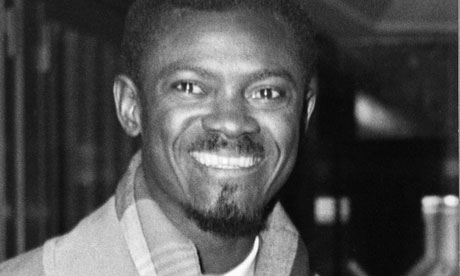
Patrice Lumumba became
the first prime minister of the Democratic Republic of the Congo in
1960, and was killed in 1961. Photograph: EPA
Patrice Lumumba, the first legally elected prime minister of the
Democratic Republic of the Congo
(DRC), was assassinated 50 years ago today, on 17 January, 1961. This
heinous crime was a culmination of two inter-related assassination plots
by American and Belgian governments, which used Congolese accomplices
and a Belgian execution squad to carry out the deed.
Ludo De
Witte, the Belgian author of the best book on this crime, qualifies it
as "the most important assassination of the 20th century". The
assassination's historical importance lies in a multitude of factors,
the most pertinent being the global context in which it took place, its
impact on Congolese politics since then and Lumumba's overall legacy as a
nationalist leader.
For 126 years, the US and Belgium have played
key roles in shaping Congo's destiny. In April 1884, seven months
before the Berlin Congress, the US became the first country in the world
to recognise the claims of King Leopold II of the Belgians to the
territories of the Congo Basin.
When the atrocities related to
brutal economic exploitation in Leopold's Congo Free State resulted in
millions of fatalities, the US joined other world powers to force
Belgium to take over the country as a regular colony. And it was during
the colonial period that the US acquired a strategic stake in the
enormous natural wealth of the Congo, following its use of the uranium
from Congolese mines to manufacture the first atomic weapons, the
Hiroshima and Nagasaki bombs.
With the outbreak of the cold war,
it was inevitable that the US and its western allies would not be
prepared to let Africans have effective control over strategic raw
materials, lest these fall in the hands of their enemies in the Soviet
camp. It is in this regard that Patrice Lumumba's determination to
achieve genuine independence and to have full control over Congo's
resources in order to utilise them to improve the living conditions of
our people was perceived as a threat to western interests. To fight him,
the US and Belgium used all the tools and resources at their disposal,
including the United Nations secretariat, under Dag Hammarskjöld and
Ralph Bunche, to buy the support of Lumumba's Congolese rivals , and
hired killers.
In Congo, Lumumba's assassination is rightly viewed
as the country's original sin. Coming less than seven months after
independence (on 30 June, 1960), it was a stumbling block to the ideals
of national unity, economic independence and pan-African solidarity that
Lumumba had championed, as well as a shattering blow to the hopes of
millions of Congolese for freedom and material prosperity.
The
assassination took place at a time when the country had fallen under
four separate governments: the central government in Kinshasa (then
Léopoldville); a rival central government by Lumumba's followers in
Kisangani (then Stanleyville); and the secessionist regimes in the
mineral-rich provinces of Katanga and South Kasai. Since Lumumba's
physical elimination had removed what the west saw as the major threat
to their interests in the Congo, internationally-led efforts were
undertaken to restore the authority of the moderate and pro-western
regime in Kinshasa over the entire country. These resulted in ending the
Lumumbist regime in Kisangani in August 1961, the secession of South
Kasai in September 1962, and the Katanga secession in January 1963.
No
sooner did this unification process end than a radical social movement
for a "second independence" arose to challenge the neocolonial state and
its pro-western leadership. This mass movement of peasants, workers,
the urban unemployed, students and lower civil servants found an eager
leadership among Lumumba's lieutenants, most of whom had regrouped to
establish a National Liberation Council (CNL) in October 1963 in
Brazzaville, across the Congo river from Kinshasa. The strengths and
weaknesses of this movement may serve as a way of gauging the overall
legacy of Patrice Lumumba for Congo and
Africa as a whole.
The
most positive aspect of this legacy was manifest in the selfless
devotion of Pierre Mulele to radical change for purposes of meeting the
deepest aspirations of the Congolese people for democracy and social
progress. On the other hand, the CNL leadership, which included
Christophe Gbenye and Laurent-Désiré Kabila, was more interested in
power and its attendant privileges than in the people's welfare. This is
Lumumbism in words rather than in deeds. As president three decades
later, Laurent Kabila did little to move from words to deeds.
More
importantly, the greatest legacy that Lumumba left for Congo is the
ideal of national unity. Recently, a Congolese radio station asked me
whether the independence of South Sudan should be a matter of concern
with respect to national unity in the Congo. I responded that since
Patrice Lumumba has died for Congo's unity, our people will remain
utterly steadfast in their defence of our national unity.