Showing posts with label United Nations. Show all posts

Saturday, January 06, 2018

UN Investigating Deaths of 14 Tanzanian Peacekeepers in Congo

  UNITED NATIONS (AP) - The U.N. is launching an investigation into attacks on peacekeepers in a part of Congo where the deadliest single assault on a U.N. peacekeeping mission in almost 25 years unfolded last month.

   Secretary-General Antonio Guterres announced Friday he's appointing longtime U.N. peacekeeping official Dmitry Titov to lead a special investigation into attacks around the town of Beni.

   The probe will focus on the Dec. 7 rebel attack that killed 15 peacekeepers and wounded over 40 others at a base near Beni. The dead were Tanzanian.

   The attack has been blamed on the Allied Democratic Forces, one of various armed groups in the mineral-rich region.

   The U.N. peacekeeping mission in Congo is the world's largest. The investigation will evaluate its preparedness and response to attacks and provide recommendations on preventing them.

In December, at an emotional ceremony held to commemorate the dead, the prime minister, Kassim Majaliwa said Tanzanians want to know what exactly happened and ‘ legal actions taken against those involved’.
‘‘The government of Tanzania is calling on the UN to conduct a thorough and transparent investigation for the spilled blood of Tanzanian soldiers, in order to know and justice be attained. It is our hope that will be done within the shortest time.’‘
Bodies of Murdered Peacekeepers returned to Tanzania for burial


Friday, December 08, 2017

Wanajeshi Kutoka Tanzania Walinda Amani wa UN Wauawa Congo

Image result for Tanzania peacekeeper
UN Tanzanian Peacekeepers

By SALEH MWANAMILONGO and EDITH M. LEDERER
Associated Press

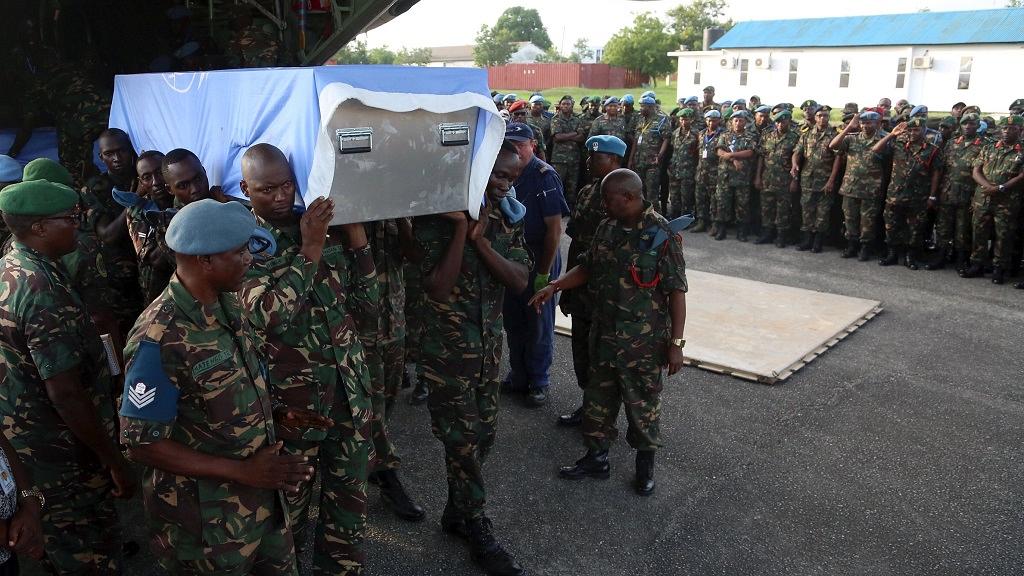
   KINSHASA, Congo (AP) - In the deadliest single attack on a United Nations peacekeeping mission in nearly 25 years, rebels in eastern Congo killed 15 peacekeepers and wounded over 50 others in an assault on their base that was launched at nightfall and went on for hours.

   U.N. Secretary-General Antonio Guterres expressed "outrage and utter heartbreak" and called the attack a war crime, urging Congolese authorities to swiftly investigate. The State Department's Bureau of African Affairs said it was "horrified."

   U.N. peacekeeping spokesman Nick Birnback said it was the deadliest attack on a U.N. peacekeeping mission since June 1993, when 22 Pakistani soldiers were killed in Somalia's capital, Mogadishu.

   The peacekeepers killed Thursday were from Tanzania. Tanzanian President John Magufuli expressed his shock and prayers for the wounded, three of whom are in critical condition. At least five Congolese soldiers also were killed in the attack Thursday evening that has been blamed on one of the region's deadliest rebel groups.

   Three peacekeepers were missing, the U.N. said. More than 20 were evacuated for medical treatment in the regional capital, Goma.

   Birnback, the U.N. peacekeeping spokesman, called the assault "a determined and well-coordinated attack by a well-armed group."

   It was not clear when military reinforcements arrived after the attack, the U.N. said. Conditions in the region are "very, very challenging," said U.N. peacekeeping chief Jean-Pierre Lacroix, who said the attack followed a recent increase in activities by various armed groups. He called the assault a response to the U.N. mission's own "increasingly robust posture."

   "We are disturbing them," he said. "They do not like it."

   The peacekeeping base is about 45 kilometers (27 miles) from the town of Beni, which has been repeatedly attacked by the Allied Democratic Forces, or ADF, rebel group. The ADF is suspected of being behind Thursday's assault. The base is home to the U.N. mission's rapid intervention force, which has a rare mandate to go on the offensive against armed groups in the vast, mineral-rich region.

   The U.N. mission in Congo is the largest and most expensive in the world. It has also been a high-profile target of the Trump administration's cost-cutting efforts. The mission has a budget of $1.14 billion and over 16,500 soldiers. Nearly 300 peacekeepers have been killed since the mission arrived in 1999, according to U.N. data.

   Members of the U.N. Security Council, which authorized the peacekeeping mission, stood in silent tribute to the victims at the start of a meeting Friday afternoon on a five-nation force in Africa's Sahel region.

   Later, the council condemned the attack "in the strongest terms," underlined that deliberate attacks targeting peacekeepers may constitute war crimes, and called on Congo's government to ensure that the perpetrators "are swiftly brought to justice."

   "This attack, the worst on U.N. peacekeepers in recent years, is a reminder of the extraordinary sacrifices made by these brave women and men every day," the council said.

   Birnback said U.N. flags will fly at half-staff Monday all over the world in memory of those killed or injured.

   Congo, the size of Western Europe, has seen immeasurable cruelty and greed as a result of its mineral resources while more than 80 percent of the population lives below the absolute poverty line of $1.25 a day. The nation suffered through one of the most brutal colonial reigns ever known before enduring decades of corrupt dictatorship. Back-to-back civil wars later drew in a number of neighboring countries.

   Many rebel groups have come and gone during the U.N. mission's years of operation, at times invading the regional capital.

   One of the greatest threats now comes from the ADF. While the fighters are mainly Muslim, experts say there are no proven links between the rebels and other extremist organizations in Africa.

   The ADF "has an agenda both ideological and extremist in nature, but also focused ... on exploitation of illegal resources," Lacroix said. He accused the rebels of preying on the local population.

   The rebels once aimed to overthrow President Yoweri Museveni's regime in neighboring Uganda. By the 1990s, they had established themselves in Congo.

   Human rights groups say at least 1,000 people have been killed in the last three years as the ADF intensified attacks in Congo. About a dozen rebels have been sentenced to death on charges related to participating in an insurrection movement.

   The U.N. mission in 2006 helped carry out Congo's first free and fair elections in 46 years. Since then, the winner of that vote, President Joseph Kabila, has become entrenched in power. Anger has grown as presidential elections originally set for late last year have been repeatedly delayed. The government has blamed insecurity for the delays.

   The U.N. secretary-general in October warned that without real progress toward elections, Congo "is likely to enter a period of extreme volatility."

   ---

   Lederer reported from the United Nations. Associated Press writer Al-Hadji Kudra Maliro in Beni, Congo contributed.

Saturday, June 24, 2017

Angola Expels Congolese

   JOHANNESBURG (AP) - Angola has expelled more than 8,000 Congolese who entered the southern African country while fleeing deadly violence at home, the United Nations says in a new report.

   The humanitarian report says more than 30,000 Congolese have fled to Angola during months of violence in Congo's central Kasai regions that began in August.

   Catholic officials in Congo have estimated that more than 3,300 people have been killed in the unrest. On Friday, the U.N. Human Rights Council voted to send experts to the region to investigate alleged abuses that include beheadings.

   More than one million Congolese have been displaced inside the country by the fighting blamed on militias and government forces, the U.N. says.

   The report says militias have used an estimated 500 girls and boys as fighters or "human shields."

   Aid access to the region has been limited by the violence, the U.N. said.

   On Saturday, Italian Foreign Minister Angelino Alfano said Italy is contributing 300,000 euros ($335,000) for U.N. refugee agency efforts to `'respond to the dramatic humanitarian emergency" in the Kasai regions to help Congolese refugees in Angola, the foreign ministry said in a statement.

   Alfano said the aid will go toward health care, food security, education and `'promoting the reliance of the vulnerable refugee populations." He said the aid aims to `'ease the burden that weighs on the Angolan government in assuring assistance and protection to the refugee population."

   The U.N. says the overall emergency aid appeal of $64 million for the Kasai crisis "remains poorly funded." The U.N. refugee agency has requested $6 million to help the Congolese in Angola.

   ---

Friday, June 03, 2016

UN Yaishukuru Tanzania Kwa Juhudi Zake za Kusaidia Kulinda Amani Nchi Zingine

 Mgeni rasmi Meja Jenerali James Mwakibolwa akipata maelezo mara baada ya kuwasili kwenye  maadhimisho ya siku ya Kimataifa ya Walinda Amani wa Umoja wa Mataifa yaliyofanyika kwenye Uwanja wa Mashujaa wa Mnazi Mmoja jijini Dar es Salaam 31 Mei, 2016.(Picha na Zainul Mzige wa Modewjiblog)
 Kutoka kushoto ni Mgeni rasmi Meja Jenerali James Mwakibolwa, Mwakilishi Msaidizi Mkazi wa Shirikala Maendeleo la Umoja wa Mataifa (UNDP), Amon Manyama pamoja na Mkuu wa Jeshi la Akiba wa Jeshi la Ulinzi la Wananchi wa Tanzania (JWTZ), Meja Jenerali, Elias Athanas wakitoa heshima kwa wimbo wa taifa wakati wa maadhimisho ya siku ya Kimataifa ya Walinda Amani wa Umoja wa Mataifa yaliyofanyika kwenye Uwanja wa Mashujaa wa Mnazi Mmoja jijini Dar es Salaam 31 Mei, 2016.

Saturday, February 01, 2014

Tanzania Iko Nyuma Kwenye UPE (Universal Primary Education) - United Nations


Overcrowded Tanzanian Primary School Classroom

UNITED NATIONS (AP) - At least 250 million of the world's 650 million primary school age children are unable to read, write or do basic mathematics, according to a report Wednesday commissioned by the U.N. education agency.

   The report found that 130 million are in primary school but have not achieved the minimum benchmarks for learning, and almost 120 million have spent little or no time in a classroom including 57 million youngsters who are not attending school.

   The independent research team that wrote the report for UNESCO, the U.N. Educational, Scientific and Cultural Organization, calculated that the cost of 250 million children around the world not learning translates to a loss for governments of around $129 billion annually.

   UNESCO's U.N. representative Vibeke Jensen said this global "learning crisis" is mainly caused by a lack of well-trained teachers, especially in impoverished areas.

   "While more children are in school, it's been at the cost of quality," she said at a news conference launching the report. "The issue now is to put the focus on quality."

   In a third of countries analyzed by the team, less than 75 percent of the primary school teachers had been trained to meet national standards.

   "Teachers have the future of this generation in their hands," UNESCO's Director-General Irina Bokova said in a statement. "We need 5.2 million teachers to be recruited by 2015, and we need to work harder to support them in providing children with their right to a universal, free and quality education."

   The report said that ensuring an equal, quality education can increase a country's gross domestic product per capita by 23 percent over 40 years.

   But according to the report, almost half the children out of school globally are expected never to make it into a classroom - and that includes almost two-thirds of girls in Arab states and sub-Saharan Africa.

   The research team reported that almost half the world's out-of-school population of 57 million live in conflict-affected areas, up from 42 percent in 2008.

   It estimated that 14 countries had more than one million children out of school in 2011 including Afghanistan, China, Congo, Somalia, Sudan before its break-up, and Tanzania.

   On the plus side, it said three countries reduced their out-of-school populations by at least 85 percent in the last five years - Laos, Rwanda and Vietnam.

   World leaders set a goal in 2000 of giving every child a primary school education by 2015 but the report said it is "likely to be missed by a wide margin."

   Sub-Saharan Africa is the region lagging farthest behind.

   The researchers forecast that if recent trends in the region continue, the richest boys will achieve the goal of completing primary education in 2021 but the poorest girls will not catch up until 2086.

Thursday, October 24, 2013

Serikali Yawataka Vijana Kujiajiri Ili Kuondokana Na Umaskini

Kwa Hisani ya Mo Blog: IMG_1784

UN Resident Coordinator Dr. Alberic Kacou arriving at the Karimjee Grounds.

.UN calls on fastest reduction of poverty to meet the MDGs

By MOblog Team

UNITED Nations (UN) members states has been told to take on board issues of youth in the Millennium Development Goals (MDGs) as part of the global community efforts to fight against organized crimes such as terrorism and drug trafficking. Moblog can report.

Speaking to invited dignitaries during the commemoration of the 68th anniversary of the United Nations in Dar es Salam at Karimjee grounds, the Minister for Natural Resources and Tourism Hon, Ambassador Khamis Kagasheki said although the MDGs is all about development but unfortunately the inclusion of youth is conspicuously absent in the eight goals.

IMG_1772

Brazilian Ambassador to Tanzania, Francisco Luz with Tanzanian Official from Foreign Affairs.

He said that according to the 2012 Population and Housing Census (PHC), the proportion of persons aged 15-35 years has decreased marginally from 35.6 percent in 2002 to 34.7 percent in 2012. The median age of the Tanzania’s population is 18 years.

Ambassador Kagasheki added that Tanzania like many other African countries suffers from youth unemployment rate of 13.4 percent. Youth employees aged between 15 and 24 years comprise only 2.5 percent of total employees in the formal sector showing the low involvement of youths in the formal sector.

“These challenges affect all segments of the population. But young people are the most affected. We are witnessing an increased trend of the youth falling victims of joining terrorists groups, drug cartels and organized crimes which is not healthy to global community welfare,”

IMG_1831

Brass Band arriving at Karimjee Grounds.

“Agricultural sector which is the main stay of most Tanzanians employs 81.4 percent. 24 percent of youths aged 15-24 years are employed in manufacturing industry followed by wholesale and retail trade comprising 17.6 percent of total youths in the formal sector. Another important industry in employing youths in Tanzania is the education sector with 15.2 percent of all youths in this sector,’ he said.

He further said that major challenges facing the youth today are lack of access to capital, negative impact of the electronic media and social networks and competitiveness in education. These are current challenges apart from the traditional ones which are drug abuse, crime, violence, sexuality and poverty.

On his part UN Resident Coordinator Alberic Kacou said that globally, this year's UN Day focuses on the eight UN Millennium Development Goals and the global partnership to achieve those goals.

IMG_1871

Guest of Honour Minister for Natural Resource and Tourism Ambassador Khamis Kagasheki accompanied by the United Nation Resident Coordinator Dr. Alberic Kacou. Left is Director of the Department of Multilateral Cooperation in the Ministry of Foreign Affairs, Ambassador Celestine Mushy and Right is Chief of Protocol Ambassador Mohammed Maharage Juma.

“In Tanzania we have chosen “The Future We Want” as the week’s theme, focusing more towards the Post 2015 Development Agenda and the role of Youth,”

“As we seek to identify the parameters of the post-2015 development agenda, the magnitude of the task before us will require decisive action and the highest levels of collaboration and we must prove our efforts to be equal to the enormity of the task,” he said

He further said that at the request of the President of the World Bank, members of the UN System Chief Executives Board (CEB) agreed unanimously in November 2012 to use its semi-annual meetings to review and improve their support to MDG progress in countries ahead of the 2015 target date. Tanzania was among the countries selected for the first review.

Kacou underscored that many nations have achieved what could have been considered a dream in 2000 – cutting in half the number of people living in extreme poverty.

Similarly, some progress is made on eliminating gender disparities in school, expanding access to safe drinking water, and improving living conditions for slum dwellers BUT progress on health, sanitation, and primary school completion is still at risk. He lamented.

IMG_1877

Above and Below: Guest of Honour Minister for Natural Resource and Tourism Ambassador Khamis Kagasheki introduced to the UN Heads by the United Nation Resident Coordinator Dr. Alberic Kacou

IMG_1876

IMG_1887

Guest of Honour Minister for Natural Resource and Tourism Ambassador Khamis Kagasheki stand for the National Anthem during the occasion of the 68th Anniversary of the United Nations at Karimjee Grounds.

He noted that UN has been encouraging an unprecedented ‘global conversation’ on the type of world that people want beyond Post 2015, through 11 thematic public consultations and surveys on the themes around— inequalities, health, education, growth and employment, environmental sustainability, governance, conflict and fragility, population dynamics, hunger, food & nutrition security, energy and water.

Kacou said the global conversation initiated by the UN engaged more than 1.3 million people in above 180 UN Member States from August 2012 to March 2013.

The report- ‘A Million Voices: The World We Want’ released by the UN Secretary General in September 2013 captures the voices from all regions and backgrounds – particularly those people that are poor, excluded or marginalized.

IMG_1897

Guest of Honour Minister for Natural Resource and Tourism Ambassador Khamis Kagasheki inspect a military parade during the 68th Anniversary of the United Nations Karimjee Grounds.

IMG_1904

A prisoner warden raising a Flag of the United Nations to commemorate the 68th Anniversary of the UN at Karimjee Grounds in Dar es Salaam.

IMG_1912

High Table: From Left is United Nation Resident Coordinator Dr. Alberic Kacou, Guest of Honour Minister for Natural Resource and Tourism Ambassador Khamis Kagasheki , Dean of the Diplomatic Corps, Amb. Juma Alfani Mpango and Member from TPDF.

IMG_1923

Above and Below are Religious Leaders.

IMG_1934

IMG_2021

The Guest of Honour the Minister for Tourism and Natural Resources, Hon Ambassador Khamis Kagasheki speaks during the climax of the UN 68th Anniversary at Karimjee Grounds in Dar es Salaam.

IMG_1961

Some of the UN Heads listening attentively to the Guest of Honour (not in picture).

IMG_1977

UN Resident Coordinator in Tanzania Dr. Alberic Kacou gives inaugural speech during the official Flag raising ceremony to mark 68th Anniversary of the United Nations at Karimjee Grounds in Dar es Salaam.

IMG_1994

Excellencies Ambassadors, High Commissioners and Heads of International Development Co-operations and Members of the Military Forces.

IMG_2039

IMG_2036

IMG_1959

United Nations Association (UNA) Secretary General Nancy Kaizilege speaks during the official flag raising ceremony on UN day at Karimjee Hall. she said the work of the United Nations Association of Tanzania has also evolved with the times and into its next era, new and creative methods of outreach, innovative tools for engagement and enhanced synergies in processes that further human rights, peace and security specifically in the Great Lakes, health, energy and climate change; and increased civic engagement in the MDGs and the Post 2015 process are at the forefront of their priorities.

IMG_2065

Guest of Honour Minister for Natural Resource and Tourism Ambassador Khamis Kagasheki in a discussion with the United Nation Resident Coordinator Dr. Alberic Kacou.

IMG_1963

Invited Guests and some of UN Staff.

IMG_2035

UN Staff from different agencies.

IMG_1997

IMG_2075

Guest of Honour Minister for Natural Resource and Tourism Ambassador Khamis Kagasheki cuts a ribbon to officiate UN Pavilion at Karimjee Grounds. Left is the United Nation Resident Coordinator Dr. Alberic Kacou.

IMG_2076

Pavilion is Official Kicks Off.

IMG_2225

Guest of Honour Minister for Natural Resource and Tourism Ambassador Khamis Kagasheki visits one of UN Pavilion.

IMG_2267

Advisor for Communication and Information at UNESCO Yusuph Al Amin elaborate a point about Community Radios and How is championing on Democratic process ahead of 2015 general election to the Guest of Honour Minister for Natural Resource and Tourism Ambassador Khamis Kagasheki.

IMG_2283

IMG_2310

UNIC Information Officer Usia Nkhoma Ledama explains a point to the Minister for Natural Resource and Tourism Ambassador Khamis Kagasheki on how the UN is empowering Youth in Tanzania.

IMG_2350

UN Communications Analyst Hoyce Temu chat with the Minister.

IMG_2201

UN Operations Adviser , Mr George Otoo shares a light moment with his colleagues.

IMG_2356

Director of the Department of Multilateral Cooperation in the Ministry of Foreign Affairs, Ambassador Celestine Mushy chat with United Nation Resident Coordinator Dr. Alberic Kacou.
Friday, January 25, 2013

Dr. Aleck Che-Mponda Atembelea Ubolozi wa Tanzania Umoja wa Mataifa

Dr. Aleck Che-Mponda alikutana na Balozi Mwakilishi wa Kudumu wa Tanzania katika Umoja wa Mataifa, Mh. Tuvako N. Manongi na Naibu Mwakilishi wa kudumu, Mh. Ramadhani M. Mwinyi, jana, Alhamisi, January 24, 2013 mjini New York.

Dr. Che-Mponda alifanya utafiti muhimu kuhusu mgogoro katika ya Malawi na Tanzania kuhusu Ziwa Nyasa mwaka 1971 kwa ajili ya Ph.D yake kutoka Chuo Kikuu cha Howard (Howard University). Dissertation inaitwa, ''The Malawi-Tanzania Border and Territorial Disputes, 1968: A case study of Boundary and Territorial Imperatives in the new Africa". Dr. Che-Mponda alimkabidhi Mh. Balozi Manongi, nakala la andiko (dissertation) lake.  Kwa wasiofahamu, Dr. Che-Mponda ni baba yangu mzazi.

Utafiti aliyofanya zaidi ya miaka 40 uliyopita umekuwa muhimu sana sasa kutokana na Rais wa Malawi, Mh. Joyce Banda kuruhusu makampuni kuchimba mafuta (oil exploration) katika Ziwa Nyasa, akidai kuwa Ziwa yote ni mali/ardhi ya Malawi.

Kutoka Kushoto - Mh. Balozi Tuvako Manongi, Dr. Aleck Che-Mponda, Mh. Balozi Ramadhani M. Mwinyi


Kutoka Kushoto - Mh. Noel Kaganda, Mh. Balozi Tuvako Manongi, Dr. Aleck Che-Mponda, Mh. Balozi Ramadhani M. Mwinyi, na shemeji yangu Stanley Harris
*************************************
Gazeti la Business Times waliandika kuhusu utafiti wa baba hivi karibuni:

Kutoka Business Times

Britain solved Malawi-Tanzania border issue in 1924, analyst says: League of Nations duly informed in 1925...


Written by MOHAMED KAZINGUMBE

Saturday, 15 December 2012
PUBLIC International Law and related laws were properly followed by the colonial authorities in drawing the border between Tanganyika Territory and Nyasaland Protectorate, a retired scholar has said, stressing that this was done following the Great War of 1914-18, when Britain was ruling both countries.


The latter country was renamed 'Malawi' on independence in 1964, while Tanganyika,which became independent on December 9, 1961, joined Zanzibar in 1964 to form the United Republic of Tanzania.Elaborating on this, Dr Aleck che Mponda – a former senior lecturer in Political Science at the University of Dar es Salaam – said Britain issued a map to that effect in 1924, showing the border as being in the middle of Lake Nyasa, and pointing on other coordinates, with River Pongwe to the north and River Ruvuma to the point where Tanzania's part of the lake ends.Noting that border clashes have threatened to worsen into a territorial war between Tanzania and Malawi twice since independence, che Mponda said it was not altogether surprising that the matter comes up again! 

The former lecturer – who hails from the shores of Lake Nyasa – sets the record straight, in elaborate detail, in an academic study conducted in the early 1970s.He points out that the first time this happened was in 1968 when Malawi, under the late Dr Hastings Kamuzu Banda as president, went about claiming that the border was at the Lake Nyasa shore on the Tanzanian side!“Had it not been for efforts to maintain the status quo, the two countries would have fought it out – much to the destruction of their economies, as each would have resorted to strong weapons for the bombing of buildings, bridges, roads, airports and so on,” Dr che Mponda states.That controversy raised eyebrows among global leaders and international institutions, prompting them to engage in fact-finding missions.

At the time, che Mponda was a student at Howard University in the United States, working on a Doctorate of Philosophy in Political Science. In the event, he made the topical Banda claims the basis of his dissertation in 1972. Business Times had an exclusive interview with Dr che Mponda this week, at which he revealed morsels of the matter the subject of controversy between Malawi and Tanzania. Details of the border delineation and related issues are on record, titled ''The Malawi-Tanzania Border and Territorial Disputes, 1968: A case study of Boundary and Territorial Imperatives in the new Africa.'

The latest dispute on the border was triggered after the Tanzania government learned that the incumbent Malawi Government under President Joyce Banda had granted a UK-based company the right to conduct oil exploration over areas of Lake Nyasa which also touch on Tanzania's shores “It is unclear how far President Kikwete and President Banda are sensing the danger ahead as the two neigbouring former British colonies squabble,” Dr che Mponda says.

“Dar has nothing to worry about, as Tanzania stands on the right side of the issue,” he claims, adding that this is on the basis of what he reckoned in examining the facts for his dissertation 40 years ago! Insisting that Public International Law and other pertinent laws and procedures were applied in 1924 by the British government to fix the Tanganyika-Nyasaland boundary, che Mponda dissertation stresses that “the line of the border is drawn right through the middle of the lake, and again to the north of the lake is Northern Rhodesia (Zambia)...”The document further reads, “to the northern tip of Lake Nyasa is River Songwe, which is in Tanzania and continues along the centre line of Lake Nyasa to a point due West of the River Ruvuma, whence the boundary runs East and joins the Ruvuma River, whose course follows to the sea...”Further details quote the authority of the League of Nations Report with Mandatory Power No 7 by His Britannic Majesty's Government on the Administration under Mandate of Tanganyika Territory, 1924. “For more details, further elaborations can be found in the Geneva League of Nations meeting of 1925 on page 5,”

Dr che Mponda specified.The retired academic seems to be conversant with the matter academically, historically – and as a son of the soil of the Lake Nyasa zone. In the event, has has nothing to gain from not telling I t like it is! At 76 years of age, he has many treasures for the new generation to benefit from.The man sees the matter “as a political issue for President Banda who came into the highest office in the land only recently, succeeding the late President Bingu wa Mutharika.“President Joice Banda would like to build confidence among her people as the country approaches the 2014 general elections... To show that she is capable of raising and working upon difficult issues which have troubled her people for decades.”

In any case, Dr che Mponda believes that the conflict would be resolved diplomatically, and that no war would emerge between the two sides, despite the fact that there are signs from various quarters to influence the issue in relation to potential oil gains. The matter will take a low profile to the end, the former lecturer maintains. Some scholars in Dar es Salaam have been puzzled by this attitude of Malawi, which has been a close of Tanzania for years. In any case, the Tanzania Ministry of Foreign Affairs & International Cooperation issued a statement after an abortive meeting between the two sides in Dar es Salaam recently, saying that the matter will now be taken for arbitration at the International Court of Justice, where it would hopefully be properly determined.

Saturday, March 31, 2012

Walimu Zimbabwe Wauza Vitabu Viliyotolewa Kama Msaada

Umasakini jamani!  Leo, kuna habari kuwa vitabu viliyotolewa na UNICEF kwa ajili ya watoto wa shule Zimbabwe, zimeuzwa badala ya kupewa wanafunzi. Aibu kweli!

****************************************************

 HARARE, Zimbabwe (AP) - Zimbabwe's education ministry says it is investigating into how school text books donated by the U.N. children's agency wind up in the hands of bookstores and street vendors.

The United Nations Children's Fund has supplied 22 million books since late 2010 after a decade of economic meltdown that left many schools without teaching materials. In some schools, scores of pupils shared a single book.

Education Minister David Coltart said Friday culprits behind the theft of books - officially the property of government schools - will be prosecuted

 The books, stamped and identifiable, sell for up to $10 on the street. A main teachers union says teachers may be stealing to make up for poor salaries.

Saturday, January 21, 2012

Dr. Asha Rose Migiro Anaondoka Umoja wa Mataifa

UN Deputy Secretary General  Dr. Asha Rose Migiro

Kutoka The Citizen

Saturday, 21 January 2012

By Mkinga Mkinga
The Citizen Reporter

Dar es Salaam. - Dr Asha-Rose Migiro is leaving her high profile posting
as deputy secretary-general of the United Nations.* Having served the
UN for five years as the second in command following a surprise
appointment in 2007, she is expected home in the next few weeks.


UN Secretary General Ban Ki Moon appointed her upon his election to
succeed Dr Kofi Annan, possibly as a reward to Tanzania, which was
said to have played a key role in helping the former South Korean
foreign minister win the job. Dr Migiro was the first woman to land
the post.

A former foreign minister herself, she is leaving at a time when Mr Ki
Moon is lining up a new team to carry forward his agenda after he was
re-elected last year for a second and final five-year term.

The permanent secretary in the ministry of Foreign Affairs and
International Cooperation, Mr John Haule, confirmed the news
yesterday.* The PS said Dr Migiro’s tour of duty at the New York based
UN headquarters was over. “We have not received an official document
from the UN, but I’m aware that her tenure is almost ending,” Mr Haule
said on the phone. “She also confirmed this development on Thursday.”

The PS noted that the UN was undergoing major reforms that were bound
to affect its offices worldwide under the “Delivering as One”
programme. “But we at the foreign affairs are not the spokespersons on
Dr Migiro,” Mr Haule added.

Separately, a source in Washington told The Citizen yesterday that
news of her imminent departure from UN was circulating among close
friends and Tanzanians living in the city.

“We have heard that she applied for an extension of her contract,”
said one of the sources in an email communication.* “But that is
likely not going to happen as sources close to her say she is planning
to return home.”
*
Dr Migiro is said to be in the process or organising how one of her
children, who is enrolled in school in New York, can complete her
studies without interruption.

She was the third deputy secretary-general and the first African woman
to hold the prestigious post that was established by the General
Assembly at the end of 1997 as part of reforms in the United Nations
to help manage secretariat operations and ensure coherence of
activities and programmes. The position was also meant to elevate the
organisation's profile and leadership in the economic and social
spheres.

In his New Year address, Mr Ban said he intended to build a new team
that was strong on substance and diverse in composition—what he called
“a team that works as one”.

He added: “Leading by example, I have placed priority on mobility,
combining fresh perspectives and institutional continuity and
synergy.”

With these criteria in mind, he said, he was undertaking a thorough
review of the entire team and its management structure.

http://thecitizen.co.tz/component/content/article/37-tanzania-top-news-story/19047-migiro-leaves-un-post.html

Friday, November 18, 2011

Prof. Chris Maina Peter of UDSM Appointed Member of the UN International Law Commission

From ASSAH MWAMBENE in New York


A Tanzanian distinguished Professor Chris Maina Peter (pictured) was yesterday voted Member of the United Nations’ International Law Commission (ILC) by the 66th UN General Assembly.

Announcing the results here yesterday, the President of the 66th United Nations General Assembly, Ambassador Nassir Abdulaziz Al-Nasser said Prof Peter is among the 34 members voted in the commission out of 49 candidates who had vied for the seats. A former Kenyan Attorney General, Amos Wako has also been voted member of the Commission.

Prof Chris Maina Peter, who is currently a Professor of Law at the University of Dar es salaam, was among13 contestants from the African continent who were vying for the nine slots reserved for the African
countries in the UN's legal body.

Prof Peter who is currently in Ethiopia for official engagement said " I am delighted for the honor and more so to my government for seconding my candidacy and a spirited campaign."

Other countries that fielded candidates from Africa South Africa, Kenya, Sudan, Libya, Algeria, Cameroon, Egypt, Malawi, Mozambique, Nigeria, Mali and Cote d'Ivoire.

Prof Peter will serve in the Commission for the period of five years effective January next year.

Prof Chris Maina Peter was born on 14th April 1954 and holds a Ph D in Law from the University of Konstanz in Germany. He once served as a Member of the United Nations Committee on the Elimination of the Racial Discrimination (CERD), United Nations High Commissioner for Human Rights, Geneva, Switzerland.

Prof. Peter has also published widely in the area of Human Rights, Humanitarian Law, Public International Law and Good Government.

Monday, October 10, 2011

Tanzania Imechaguliwa Kuwa Mjumbe wa Baraza la Utendaji la Shirika la Dunia la Utalii - UN WORLD TOURISM ORGANIZATION

PRESS RELEASE

JAMHURI YA MUUNGANO WA TANZANIA

WIZARA YA MALIASILI NA UTALII

TAARIFA KWA UMMA

TANZANIA IMECHAGULIWA KUWA MJUMBE WA BARAZA LA UTENDAJI LA SHIRIKA LA DUNIA LA UTALII

(UN WORLD TOURISM ORGANIZATION)

Tanzania imechaguliwa kuwa mjumbe katika Baraza la Utendaji (Executive Council) la Shirika la Utalii Duniani – United Nations World Tourism Organisation (UNWTO). Nafasi hiyo ilipatikana wakati wa Mkutano Mkuu wa Shirika la Utalii Duniani (UNWTO General Assembly) ambao ulianza za siku ya Jumamosi tarehe 08 Oktoba, na utakamilisha shughuli zake tarehe 14 Oktoba, 2011 nchini Korea.

Katika Mkutano huo, ujumbe wa Tanzania unaongozwa na Waziri wa Maliasili na Utalii, Mheshimiwa Ezekiel M. Maige ambaye ameambatana na viongozi na wataalam waandamizi kutoka wizara hiyo.

UNWTO ni shirika la Umoja wa Mataifa linaloongoza masuala ya Sera, Mafunzo, Uendelezaji na Utangazaji katika sekta ya utalii duniani.

UNWTO inatekeleza majukumu na maamuzi kuhusu maendeleo ya utalii na kutetea maslahi ya nchi zinazoendelea. Aidha, Shirika hili linahimiza utekelezaji wa Maadili katika Utalii kwa kuhakikisha nchi wanachama zinanufaika kiuchumi na wakati huo huo kupunguza athari za kijamii na kimazingira.

Hadi wakati wa Mkutano huu wa Korea, UNWTO ilikuwa na nchi wanachama 154. Idadi hii itaongezeka hadi kufikia 155 baada ya Liberia kukubaliwa ombi lake la kuwa mwanachama.

Kazi kuu ya Baraza la Utendaji la UNWTO, ambalo Tanzania imefanikiwa kuwa mjumbe ni kuchukua hatua zinazostahili, kwa kushirikiana na Katibu Mkuu wa Shirika hilo kutekeleza maamuzi yanayotolewa na Mkutano Mkuu (UNWTO General Assembly). Baraza hukutana mara mbili kwa mwaka. Tanzania itakuwa mjumbe wa Baraza hilo hadi Mwaka 2015.

Akizungumza baada ya uchaguzi huo, Waziri Maige alielezea sababu ya Tanzania kugombea nafasi hiyo muhimu ni kutaka kuwa ndani ya chombo cha maamuzi na hivyo kushawishi maamuzi yatakayoinufaisha Tanzania na kujitangaza zaidi Duniani katika uwanja wa kimataifa wa masuala ya Utalii.

Wednesday, September 24, 2008

Rais Kikwete alivyozungumza Umoja wa Mataifa


Nimependa alivyoongea Rais Kikwete huko kwenye Umoja wa Mataifa. Lakini angeongeza kuwa nchi zilizoendelea hasa Marekani zimejengwa kiasi kikubwa na watu wenye asili ya Afrika walioibwa kutoka kwao na kuzalimishwa kufanya kazi (utumwa). Waliteswa ile mbaya huko nchi inajengwa wakati hali Afrika ilizorota shauri ya kupoteza watu, kuchomwa moto vijiji na maovu mengine katika jina la kukamata watumwa. Hivyo ni wajibu wao kusaidia Afrika.
Na wasilete excuse eti utumwa ulitokea hapo zamani za kale. Bado wanakula matunda ya mababu na mabibi zetu!


Kwa habari zaidi za utumwa Marekani someni:
http://en.wikipedia.org/wiki/Slavery_in_the_United_States

***************************************************
Kutoka ippmedia.com

Aid to Africa historical duty, not charity

2008-09-24
By Guardian Correspondent, New York


President Jakaya Kikwete yesterday told the developed nations that it is their historic duty and moral obligation to help Africa. He said the help should not be considered as a charity.

President Kikwete made the statement at a high level meeting on Africa`s development needs held at the United Nations offices in New York.

``I would like to express Africa`s disappointment at the failure of the developed nations to honour their commitments to provide resources to deal with the challenges of Africa`s development. It is their historic duty; it is a moral obligation to help the needy in Africa. It is not charity,`` the chairman of the African Union said.

Kikwete said that development required high amounts of resources which Africa lacked, unfortunately because of its low levels of development.

``Africa has no sufficient resources to pull itself out of the poverty trap,`` he said, adding, ``The good thing is that all of us, in the continent and in the international community, recognise the question of Africa?s acute resource constraint. We also know that African governments have been taking measures to tackle their development challenges using the little resources available.``

Kikwete said the international community had been generous enough to assist African nations with resources to compliment their efforts, although the resources being committed and being made available are not sufficient to lift Africa out of the poverty trap quickly.

The AU head further pointed out that a lot of resources promised by the developed countries were not provided to needy Africans on time.

He recalled the Monterrey Consensus adopted by heads of state and government in March 2002, saying the consensus provided a key framework for financing development.

``We, in Africa, saw the adoption of the consensus as an important step in scaling up efforts to mobilise domestic and external resources for our development and that of other needy developing nations on this planet,`` Kikwete said.

?It is only prudent that, as we elevate Africa`s development agenda as a matter of global concern, we take stock as to where we are on the implementation of the Monterey Consensus and other decisions taken at different international fora,`` he added.

The AU chairperson said Africans were appreciative of several efforts that had been made in recent years to address the challenges of financing the continent`s development needs.

``These efforts are reflected in the 2005 World Summit Outcome, the 2005 Paris Declaration on Aid Effectiveness, and the 2005 G-8 Gleneagles Summit Declaration``, he said.

President Kikwete commended the G-8 countries for increasingly paying more attention to development issues affecting Africa, stressing that all these efforts had added momentum to commitments made by the world class leaders in the Monterrey Consensus.

``We in Africa are concerned at the persistent gap between what has been promised and what has been delivered. Collectively, the G8 are badly off track with their development assistance promises to Africa,`` he said.

He however, acknowledged that in total, G8 assistance to sub-Saharan Africa has increased by only USD 2.3 billion since 2004, when it should have increased by USD 5.4 billion over that period.

?If current trends continue, African countries will not be able to mobilise the resources required to finance the public investments critical to achieving the MDGs.

Now is the time, for friends of Africa in the developed world to walk the talk.

Not doing so now may be too late, as far as meeting the 2015 targets is concerned,? President Kikwete said.

SOURCE: Guardian

Tuesday, May 27, 2008

Watoto wadogo walazimishwa kufanya ngono ili wapate Chakula!


Jamani! Unaweza kulia baada ya kusikia habari hizi! Kumbe huko Haiti, Sudan, Ivory Coast na nchi zingine watoto wadogo wenye miaka sita wamelazimishwa kufanya ngono na kupiga picha za uchi kusudi wapate chakula kutoka kwa wafanyakazi wa vyama vinavyotoa misaada.
Wanasema kuwawalinda amani (Peacekeepers), na watoa misaada wa vikundi mbalimbali wamo kwenye orodha ya wanaonyanyasa watoto wadogo. Wanasema kuwa mara nyingi uhalifu kama huo unatokea kwenye makambi ya wakimbizi. Huduma mpaka kwa ngono! Habari zinasema wamelazimisha hata watoto wenye miaka sita kufanya ngono!
Huko Haiti binti wa miaka kumi na tano alisema kuwa alikuwa antembea na rafiki zake. Wakakutana na kundi la wafanyakazi wa chama kimoja cha misaada. Walitoa bolo zao kwenye suruali na kuwaambia wazinyonye ili wapate hela. Yule binti alikataa lakini rafiki zake walikubali na kupewa vihela na pipi.

Ubaya zaidi ni kuwa ingawa wenyeji wanajua inatokea nini, hawasemi kitu. Wanaogopa kuwa kama wakilalamika misaada itaacha kuja.

Lakini hebu mjiulize. Ni watu gani wanaofanya kazi kwenye hizi kundi? Mara nyingi ni watu waliokosa kazi kwao! Je, wanapimwa akili kabla ya kupewa kazi muhimu kama kwenda kugawa chakula au kulinda amani.

Lazima nisifu ripoti waliotoa Save the Children. Wamefanya kazi nzuri mno ya kuumbua hao washenzi!
Kwa habari zaidi someni:


Saturday, September 08, 2007

Hafla ya Kumpongeza Dada Asha Rose Migiro New York


(All Photos courtesy of Issac Kibodya)
Kumbukumbu ya hafla ya Dr. Asha Rose Mtengeti Migiro ilofanyika Pelham, New York kumkaribisha Marekani na kupongeza kwa kuchaguliwa kuwa Katibu Mkuu Msaidizi wa Umoja wa Mataifa tarehe 25 Agosti 2007.